

















Iroquois eaglet, 38 days old on Monday, halfway through nestling stage
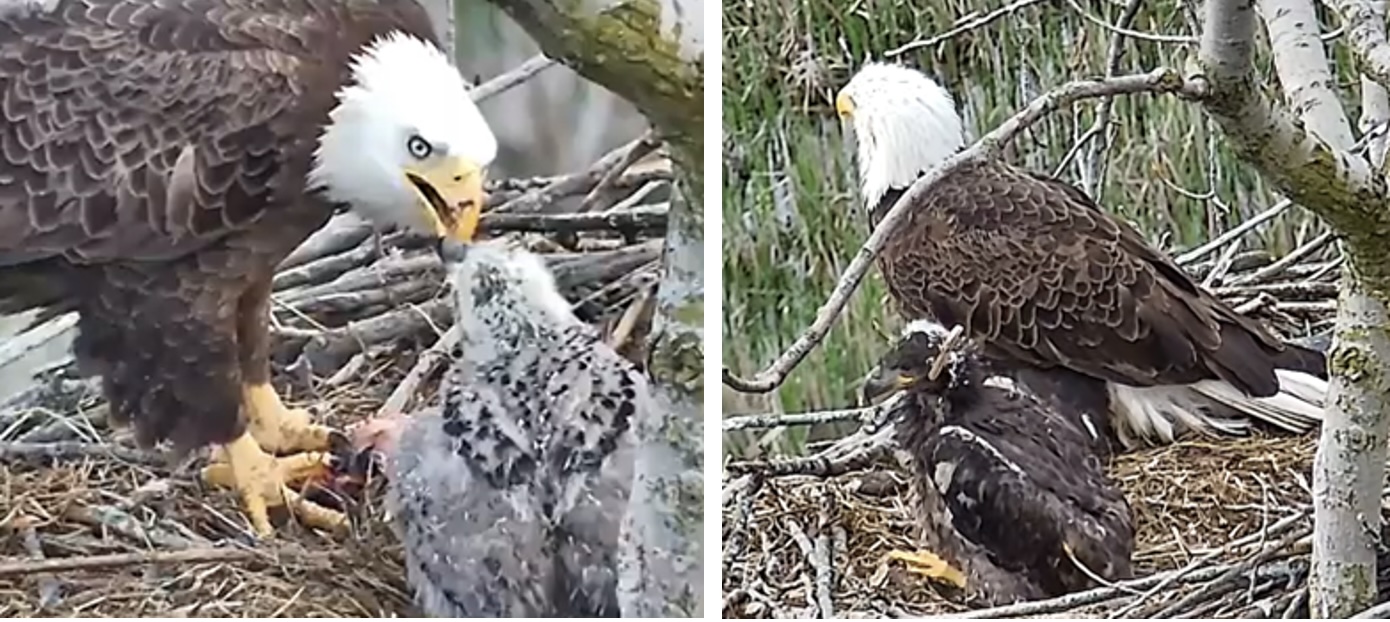
Photos and information from Friends of Iroquois National Wildlife Refuge
The eaglet at Iroquois National Wildlife Refuge that many have been following through the bald eagle nest camera was 38 days old as of Monday and is growing by leaps and bounds.
Just like human babies, the eaglet is doing a lot of eating and sleeping. Sometimes both: Mother eagle brought in a juicy catfish the other day and the chick wasn’t hungry so used the catfish for a pillow – at least when the catfish stopped flopping about. Another time father eagle brought in a stick, disappointing the chick who was looking for some fish bits.
As an only chick, the eaglet is being fed very well so is growing fast and hitting all its important behavioral and physical milestones.
It is taking much larger bites of food, including being able to digest fur, feathers, scales and small bones. It reaches toward the parents and pecks at them to ask for food. It partly helps itself by picking up and eating dropped pieces of food. Its body feathers are growing in and the primary flight feathers can be seen poking out of the sheathes at the wings and tail.
The eaglet is also entertaining camera viewers with more “wingersizing” – an eagle version of calisthenics. It is gaining more strength in its legs, and you will see the eaglet standing up more often. Once it gains more stability in those legs ─ “riding the rails” is a term used on eagle cameras ─ the chick will start to perch near or on the sticks surrounding the bole.
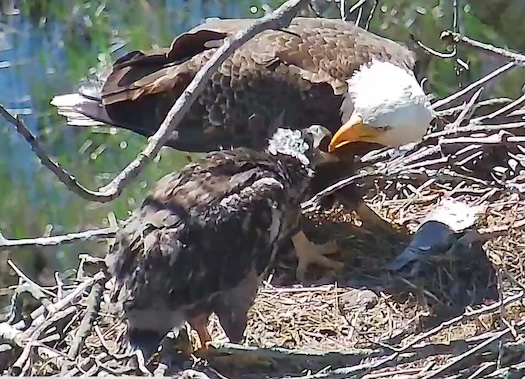
The camera was funded and installed by the Friends of Iroquois National Wildlife Refuge, with assistance from Pixcams Inc., out of Pittsburgh, and Treeman Tom tree service out of Wilson. You can watch the feed on a monitor in the refuge Visitors Center on Casey Road in the town of Alabama, or through a link at the Friends group’s website, FINWR.org.
If you’re keeping track, the eaglet is about halfway through its nestling phase.
Next the eaglet will be doing more standing and walking in the fully upright adult posture instead of scooting around using its hocks and wings. It is already starting to do this, but it will happen more often. In the next few weeks, it will also start doing more practice flapping to build breast and wing muscles.
In about four weeks it will start hopping and flapping to practice hovering above the nest. At this point its feathers will be much more grown in and the bird will be fully dark brown. It will also be able to feed itself from prey items brought to the nest, although the parents will continue to feed it.
Toward the end of June, the juvenile will be able to balance and perch on branches, hover reliably above the nest and flap from branch to branch. The primary wing and tail feathers will be almost entirely grown. It should fledge (be ready for its first real flight) in late June or early July at around 72 days old.
The eaglet will typically hang around a few weeks after fledging but then head off to seek its own territory. It will retain its dark brown coloring for several years and won’t develop its adult plumage ─ the iconic white head and tail feathers of a bald eagle ─ until it’s almost five years old. Until then it is scoping out other territories, play learning with other juveniles and perfecting its hunting techniques.
A final note: Friends group President Dick Moss would like to thank everyone who came out to Iroquois National Wildlife Refuge for Saturday’s Spring Spectacular. Everyone had a great time and the eaglet and its parents were one of the main topics of conversation.
“A special thanks to the vendors who shared their environmental expertise, and especially to the refuge staff who made it all possible,” Moss said.
This eaglet update was a collaboration of Friends of Iroquois NWR group members Dick Moss, Emma DeLeon, Amy Merritt and Garner Light.