
















Lyndonville saw big boom in growth in early 1900s
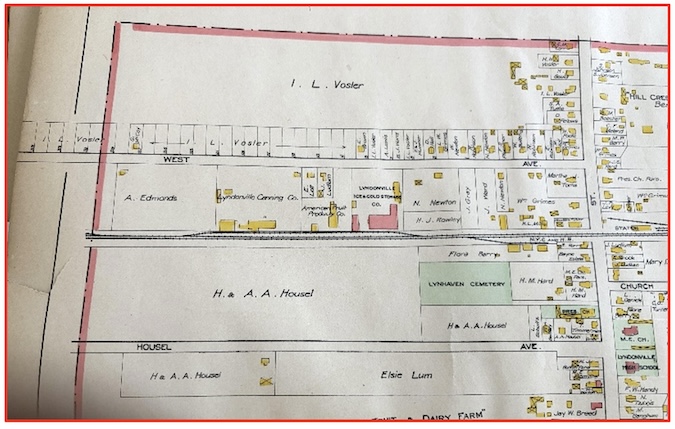
This 1913 map of Lyndonville shows a concentration of food processing plants adjacent to railway line and open area advertised by H.A. & A.A. Housel. (New Century Atlas of Orleans County, 1913)
By Catherine Cooper, Orleans County History
“Illuminating Orleans” – Volume 6, No. 3
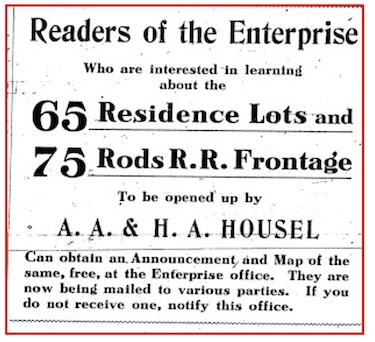
An ad from Lyndonville Enterprise on January 27, 1910
“LYNDONVILLE – HER PROGRESSIVE HEALTHY GROWTH,
“AND WHAT IT MEANS FOR THE FUTURE –
“REAL ESTATE MARKET IS ACTIVE”
“Put me off at Lyndonville” (station)
“Why?”
“Oh! Lyndonville is such an enterprising little town that it has become a desirable place in which to settle and invest money. It is wonderful how prices are soaring and if you want to be “in it” you must “get there” right quick.
Why, within this past year, 15 new dwelling houses, at a cost of from $2,500 to $3,000 have been erected and more are to be built by spring and these mostly by retired farmers in our town who have so prospered by big crops and good prices that they have been able to pay off their mortgages and still have money enough to buy a village lot at a cost of $300 to $400 and erect an elegant house with all modern improvements from a furnace to electric lights.
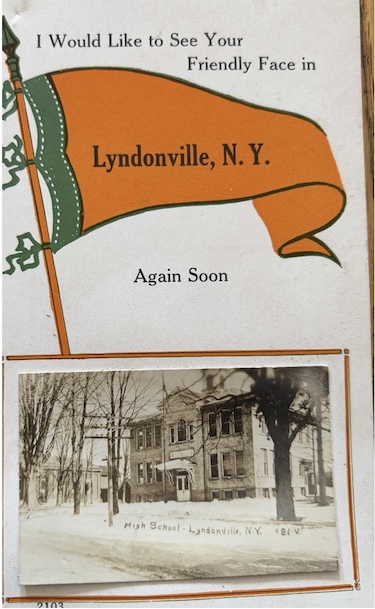
Small wonder then that Lyndonville was the subject of postcards such as this 1910 era card from the Balls-McComb collection.
In addition, this past year, the Lyndonville Ice and Cold Storage plant was built at a cost of $125.000; Barnum’s brick hotel at a cost of $4,500; the Lyndonville cement Automobile Garage; N.J. Barry’s cola building with an electric elevator. F.D. Langdon’s new drive barn is in progress, as are plans for a new general store and opera house.”
This article was originally published as a centerpiece on page one of the Lyndonville Enterprise of January 27, 1910. The Housel ad. appeared in the same issue.
Lyndonville’s prosperity referred to can be attributed to the transportation service provided by the Rome, Watertown and Ogdensburg Railroad. The first train passed through on June 12, 1876. For the next 70 years, freight and refrigerated trains transported the area’s fine produce to market while passenger trains carried passengers to Rochester and Buffalo.
While Yates Center was the site of the first settlement in the Town of Yates, it was soon eclipsed by the growth of Lyndonville just a short distance south. The Johnson Creek waterfall provided a source of power, essential at that time for operating mills. A grist mill was built in 1836. Other businesses soon followed.
The village was incorporated in 1903. In 1908, the village contracted with the Swett Electric Light and Power Company to provide electric lamp posts on Main St. Electric power was also available for the newly built “elegant houses.”