
















Iroquois refuge opens pollinator meadow at Cayuga Overlook
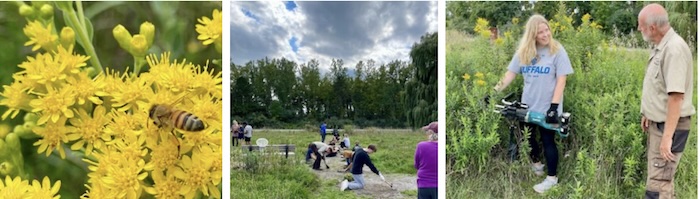
Photos by Tavi Moss: (Left) A bee hovers around a stuff goldenrod bloom at the Iroquois refuge’s new pollinator meadow. (Center) For the Pollinator Meadow dedication on Saturday, a group of UB students helped plant more native plantings and weeded the meadow pathways. (Right) UB sophomore Maddie Kennedy works an augur to dig a hole for a new ironweed planting under the supervision of Dave O’Donnell.
Press Release, Friends of Iroquois National Wildlife Refuge
BASOM – Iroquois National Wildlife Refuge celebrated its new pollinator garden on Saturday at the Cayuga Overlook.
The meadow was mostly the work of Dave O’Donnell, president of the Eastern Monarch Butterly Farm in Clarence.
“This was a wonderful team effort, and we will continue to enhance this area to benefit pollinators and other wildlife,” said O’Donnell. “The vision was to create a minimal, maintenance, meadow. With funding from FINWR (Friends of Iroquois National Wildlife Refuge), and the support of USFW (US Fish & Wildlife Service) staff and volunteers, we have accomplished this.”
A group of students from the University at Buffalo attended and saw a butterfly banding — it’s really more of a sticker applied to a wing — planted some native plants, including ironweed, and contributed some much needed weeding to the path area.
FINWR President Richard Moss of Medina thanked the students for their efforts and O’Donnell for all his hard work on the project, which has been under way for at least three years. Moss also encourages the community at large to visit and make use of this new feature.
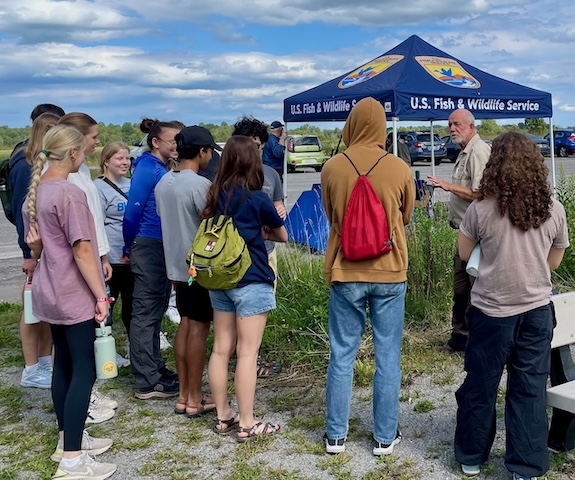
Dave O’Donnell, second from right, president of the Eastern Monarch Butterfly Farm in Clarence, tells a group of University at Buffalo students about some of the native plants he used in the refuge’s new pollinator garden.
The area where the pollinator meadow now exists had been part of the Cayuga Overlook parking lot, but the USFWS — which runs the refuge — decided that the lot was too big and let grass and hardpan take over a large section between the lot and Route 77. Using native plants and a lot of sweat, the area has been transformed into a small meadow with a path and benches where you can sit and watch the pollinators flit about.
Depending on conditions, the area is now abuzz with bees and other insects, and a walk through will send frogs and toads scurrying out of your way.
One of the cool events Saturday was O’Donnell’s demonstration of butterfly banding. O’Donnell, using a butterfly net, caught a pair of monarchs that were flying around the garden and showed how a tiny sticker with contact information can be applied to the wing of a butterfly so its journey can be traced if it is found in the future. These monarchs will be headed off to Mexico soon, one of nature’s epic migrations.
O’Donnell encouraged everyone to get involved in similar efforts to improve the environment.
“Now more than ever, with recent cuts to vital programs and services, we need to increase our presence and protect our environment for future generations,” O’Donnell said. “I encourage everyone to lend a hand and support these organizations however you can.”