












Page Sponsor





No. 3 seed Holley upended No. 2 Red Creek 1-0 in the semifinals of the Section V Class C1 girls soccer playoffs this evening at Red Creek.
Carsyn Mogle scored the lone goal for the Lady Hawks in the first half off an assist from Emma Burne.
Zoey Warner made 2 saves to earn the shutout in goal as the Lady Hawks improve to 13-5-1.
Holley will next face the winner of the other semifinal between No. 1 Avon and No. 4 Byron-Bergen/Elba in the Class C1 championship game at 7:30 p.m. Friday at Geneseo High School.
Wilson 2, Portville 1 (OT)
Top seeded Wilson edged No. 5 Portville 2-1 in overtime in the semifinals of the Section VI Class C girls soccer playoffs this evening at Wilson.
Wilson will now face No. 3 Frewsburg for the Class C championship on Friday at Allegany-Limestone. Frewsburg downed No. 2 Holland 4-2.

Rendering from Empire State Development and Governor’s Office: The Canal Basin parking lot along the Erie Canal will be turned into a “waterfront gateway” complete with green space, seating areas and boater/cyclist amenities as part of the NY Forward grant in Medina. This is not the final design for the parking lot. This is not the final design of the project.
MEDINA – The Village Board on Monday hired an engineering and design firm for a new look of Medina’s Canal Basin, a project that will better connect boaters and pedestrians to the basin, and improve the aesthetics of a space that is heavily asphalt.
Village officials last week interviewed six firms that submitted proposals for the project. On Monday, the Village Board hired Fisher Associates in Rochester.
Fisher called its proposal for the project, “Distinctly Medina: A Generational Vision for the Canal Basin.”
Fisher, in its presentation to the village, said the project will create “Medina’s definitive place on the Erie Canal for the next 20 years and beyond.”
The Village Board hired Fisher with the design services of the Canal Basin at $111,615 with an additional $17,955 for engineering and design work for electric car charging stations. It would be another $18,995 if a topographic survey is needed.
The Canal Basin parking lot will redesigned as part of a $1.345 million grant from the state. The new lot will have less asphalt and more green space. The parking lot will lose about 15-20 spaces. There will be about 70 spots remaining.
The project will add green space, seating areas and boater/cyclist amenities.
The redesigned basin was awarded $1.345 million of the $4.5 million from the state to Medina in the NY Forward grant. The state finalized eight projects for the $4.5 million on May 17, 2024. The transformed parking lot received the largest grant of the eight projects.
The village is looking to upgrade the entry drive from Main Street; enhance the pedestrian walkway extending from Main Street, across rear building facades, to East Center Street alleyway; add a gazebo for shade and cover; expand flexible greenspace areas for programming with amenities including seating tables, benches, bike racks, shade trees and native plantings; and add pedestrian walkways with decorative, permeable pavers.
The redesign of the basin parking lot also will include two direct-current fast chargers for electric vehicles, each with two charging spots. The state awarded Medina $245,184 in a separate grant for those chargers with National Grid also chipping in $73,000.
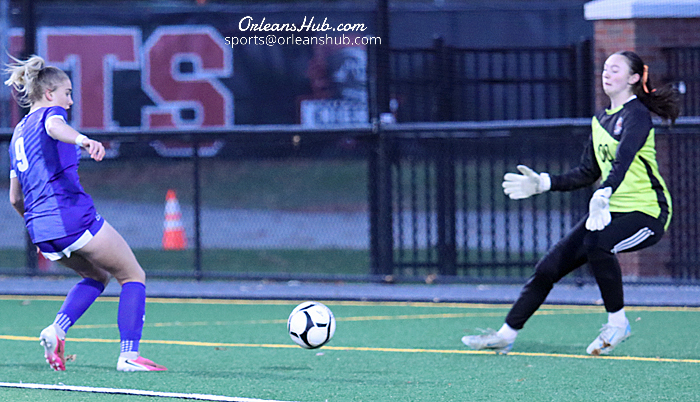
Photos by Cheryl Wertman – Jersie Drake scores Kendall’s first goal as the Lady Eagles went on to down Genesee Valley Belfast 6-1 in the Class C2 semifinals this evening at LeRoy.
A quick two goal scoring burst in the first 10 minutes ignited top seeded Kendall to a 6-1 victory over No. 5 Genesee Valley Belfast in the semifinal round of the Section V Class C2 girls soccer playoffs this evening at LeRoy.
Jersie Drake scored just 6 minutes in and Ryleigh Denning followed up with a goal just 4 minutes later to put the Lady Eagles in control.
Kendall also started the second half as strongly as the first exploding for three goals in the first 10 minutes to break the contest wide open.
Denny had a pair of goals and Sophia Picardo 1 during that stretch to vault the Lady Eagles out to a commanding 5-0 lead.
Mackenzie Cooper rounded out the Kendall scoring parade with a goal in the final two minutes.
Drake also had 2 assists as Picardo, Denning and Addison Kludt each had 1.
Teagan Shaw made 3 saves in goal for the Lady Eagles.
The Genesee Valley Belfast goal came with 18 minutes to go in the second half.
Improving to 17-1, Kendall will now face No. 6 seed Fillmore in the Class C2 championship game at 5 p.m. Friday at Geneseo High School. Fillmore upset No. 2 Keshequa 2-1.
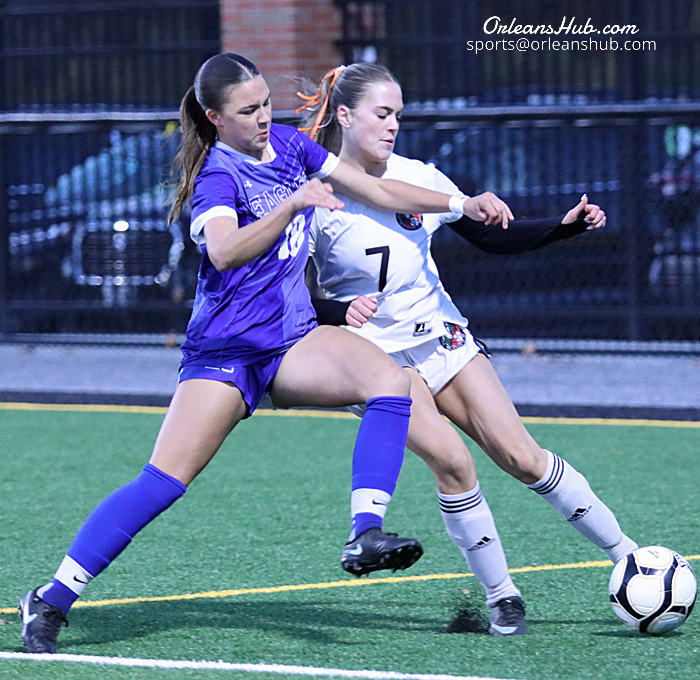
Kendall’s Ryleigh Denning, who scored 3 goals, battles for control of the ball with Genesee Valley Belfast’s Emma Calanni.
We appreciate input from our readers, and we publish letters to the editor without charge. The letters should be written by the person who submits the letter and not be “ghost written” by someone else. While open speech and responsibility are encouraged, comments may be rejected if they are purely a personal attack, offensive or repetitive. Comments are the opinions of the authors and do not necessarily reflect the opinions of Orleans Hub. Although care is taken to moderate comments, we have no control over how they are interpreted and we are unable to guarantee the accuracy of comments and the rationality of the opinions expressed. We reserve the right to edit letters for content and brevity. Please limit the length of your letter (we suggest no more than 500 words) and provide your name, telephone number, mailing address and a verifiable email address for verification purposes. Letters should be emailed to news@orleanshub.com.
Editor:
If you haven’t yet attended a performance of the Hoag Music Series you’ve missed some wonderful entertainment. From March until December on scheduled Saturdays at noon Jim Doyle arranged for some great music for our community.
On October 10th, the concert featured Evie Ladin who sang, played the banjo and did some percussion dancing that was awesome. She performs all over the country, is based in NYC and Jim promises that she will be back. You should not miss her.
Os Pipe and Fiddle Witch Duet will be here on Saturday, November 7th for a blend of East and West.
The Rochester Ukelele Orchestra will be at the Hoag on Saturday, December 5th at noon. Bonus: Gary Simboli will lead a Christmas Carol sing along at 2 that afternoon too!
All performances are free. December 5 closes the series for 2026. Jim promises that next year’s series, starting in March, will be awesome too. Look for them, put them on your calendars and enjoy!
Catherine Moore
Albion
Editor:
I am writing to encourage residents, veterans, and local organizations to petition Orleans County school districts to hold public hearings on the newly authorized property tax exemption for permanently and totally disabled veterans under New York State Real Property Tax Law §458-a(11).
This legislation gives local governments and school districts the authority to provide a full property tax exemption to qualifying veterans who have been permanently and totally disabled as a result of their military service. However, each taxing jurisdiction must decide whether to adopt it.
Monroe County has already adopted the exemption, and some school districts have begun taking action. Yet here in Orleans County, there has been little public discussion about whether our school districts intend to offer this benefit.
I am a permanently and totally disabled combat veteran who served in Iraq. I live within the Kendall Central School District, which does not currently participate in the Alternative Veterans’ Exemption. I recently contacted the district’s Board of Education president to ask whether the new exemption had been discussed or would be considered. I was informed that the board had not discussed it and that there was no timeline for doing so.
This raises a larger question: Why should disabled veterans have to appear personally before a school board just to get elected officials to discuss a benefit that the state has already authorized?
Many permanently and totally disabled veterans live with serious physical injuries, PTSD, anxiety, and other service-connected disabilities. For some, appearing before a room full of people to publicly discuss their disabilities or advocate for themselves can be extremely difficult.
These veterans have already demonstrated their disabilities through the Department of Veterans Affairs. They should not have to stand before another government body and explain why their sacrifices deserve consideration.
I recognize that adopting this exemption has financial implications for school districts and taxpayers. Those implications deserve an open and informed discussion. That is precisely why I believe public hearings are appropriate.
I am calling on the Boards of Education in Kendall, Albion, Holley, Lyndonville and Medina to publicly consider this exemption, hold hearings, and give residents an opportunity to understand its potential benefits and costs.
I also encourage local veterans’ organizations, including VFW and American Legion posts, to help organize petitions and advocate for these discussions.
This is not a demand that school districts automatically approve the exemption. It is a request that they put the issue on their agendas, examine the facts, and make a decision in public.
Our disabled veterans should not have to fight another battle simply to have their needs considered.
Respectfully,
Dan Brundage
Kendall Central School District resident
Iraq War veteran
Photos by Tom Rivers
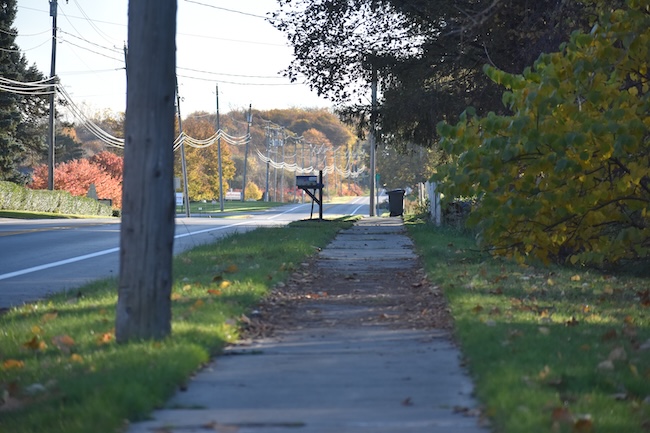
ALBION – Sidewalks run along the south side of East Avenue but stop across the road from St. Joseph’s Catholic Cemetery.
Albion town officials would like to see a joint project with the town and village to extend sidewalks to the Butts Road intersection and then going north on Butts past a healthcare site and then to a UConnectCare residence.
The Albion Town Board discussed the issue during its board meeting on Monday evening. The board said it will reach out to the village about a joint effort, and also see if there is any state funding to help with the sidewalk.
Mike Neidert, the Albion town highway superintendent, said he the sidewalks would be safer for pedestrians and people using scooters and wheelchairs to go to the healthcare facility and UConnectCare.
“This would be a great project,” he said. “There are a lot of pluses.”
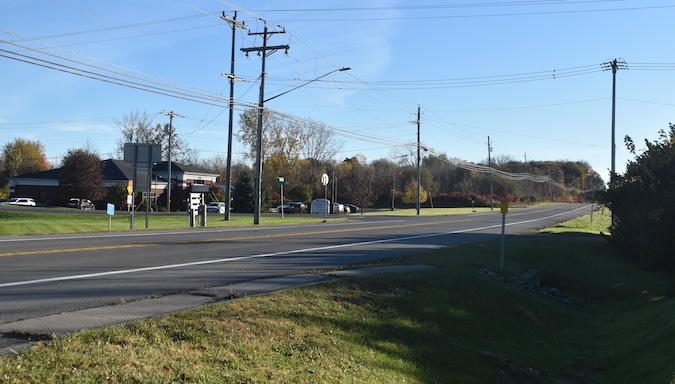
Orleans Community Health in 2012 opened the healthcare center at the northeast corner of Butts Road and Route 31.
UConnectCare last November opened a residence that can serve up to 25 women including 5 bedrooms for women with young children.
Neidert said both UConnectCare and Orleans Community Health would like an extended sidewalk down Route 31 and on the section of Butts Road, as well as a crosswalk at the intersection.
The highway superintendent said the town and village could discuss having mucnipal employees install the sidewalks. He estimated there would be about 600 feet of sidewalks that the town would be responsible for, while the village would have about 1,500 feet.
He would like to see the town and village leaders reach out to Assemblyman Steve Hawley and State Sen. Rob Ortt to see if they could secure funding for materials for the sidewalks. He estimated the materials for 600 feet of sidewalks for the town’s portion would be about $10,000.
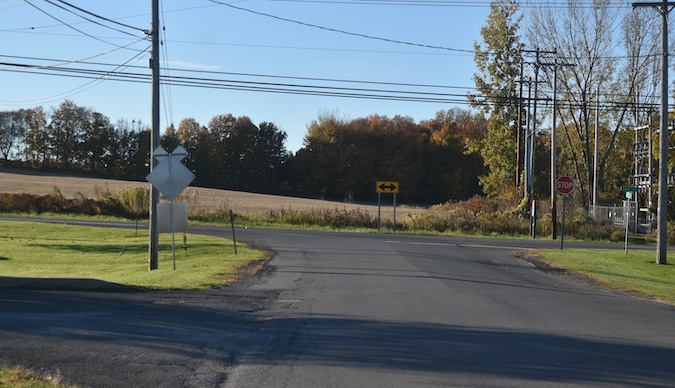
Mike Neidert, the Albion highway superintendent, would also like a cross walk at the intersection.
Editor:
My name is Kathy Harnischfeger, and I am a write-in candidate for Clarendon Town Supervisor.
I am writing in response to the SCOPE article. If elected, I will take seriously my oath to uphold the Constitution and will base my decisions on evidence, facts, and the best interests of our community—not on personal opinion.
I did not attend the SCOPE debate or respond to Mark Allen’s questionnaire because I have been focused on listening directly to residents and understanding their concerns through my door-to-door campaigning.
Across the community, people have consistently raised issues such as high taxes, rising energy costs, public safety, sewer infrastructure, and other local priorities. The Second Amendment has not been among the concerns most frequently raised with me.
For the record, I am a gun owner and support the right to bear arms. I also strongly support the First Amendment freedom of speech. These rights carry important responsibilities, and they should be approached with care and respect.
I encourage Clarendon voters to look beyond distractions and misinformation and to focus on the facts. This is an important moment for our community and an opportunity to demonstrate our commitment to honest, responsible local government.
Every eligible voter has a voice in Clarendon’s future. Please make a plan to vote and participate in this important election.
Sincerely,
Kathy Harnischfeger
Clarendon
Top seeded Wilson blanked visiting No. 5 Randolph 2-0 Monday evening in the semifinals of the Section VI Class C boys soccer playoffs.
Gage Gailie and Hayden Fellows scored the goals for Niagara-Orleans League champion Wilson which improves to 16-1-1.
The Lakemen will now face No. 2 seed Ellicottville-Franklinville in the championship game on Friday at 7:30 p.m. at Hamburg.
Ellicottville-Franklinville downed No. 3 seed Westfield-Brocton 3-0 in the other semifinals.
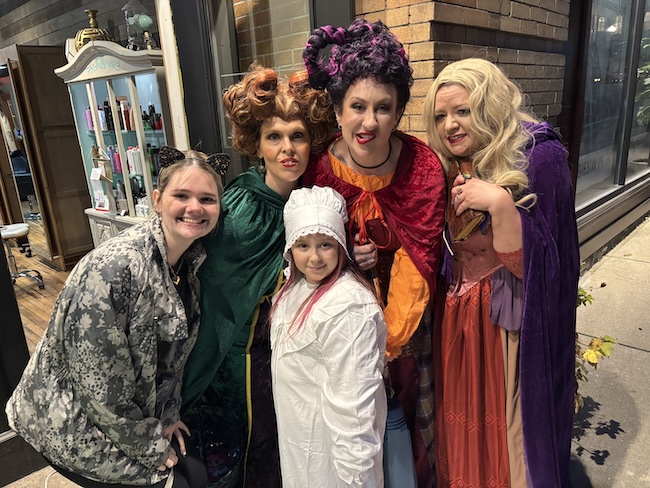
Photos by Tom Rivers: During Beggar’s Night last year on Oct. 25, the Fringe not only passed out candy but dressed up as characters from Hocus Pocus. In front, Khloe Mank, 9, is Emily Binx. In back from left are Leah Printup as Thackery Binx (the iconic cat), Jennifer Printup as Winifred Sanderson, Amanda Mank as Mary Sanderson, and Vanessa Lhommedieu as Sarah Sanderson. Lhommedieu is owner of The Fringe.
It will be candy galore and many kids in costume during Beggar’s Night on Friday in the Albion and Medina downtown business districts, and then on Saturday in Holley for the Hallow Fest.
Hundreds of children are expected in the downtowns of all three villages for the events.
The Albion Merchants Association is organizing Beggar’s Night in Albion from 5 to 7 p.m. Many businesses and organizations will be giving out treats to children. There will be a bonus of 20 gold bars filled with candy and goodies to some of the kids in the best costumes.
There isn’t a specific starting spot. The trick or treating line goes in a loop. People can park behind the fire department, next to Courthouse Square or the small municipal lot on Platt Street.
Medina businesses will have Beggar’s Night from 5:30 to 7 p.m. The starting point is the Print Shop on East Center Street and attendees often line up through the parking lot behind the buildings.
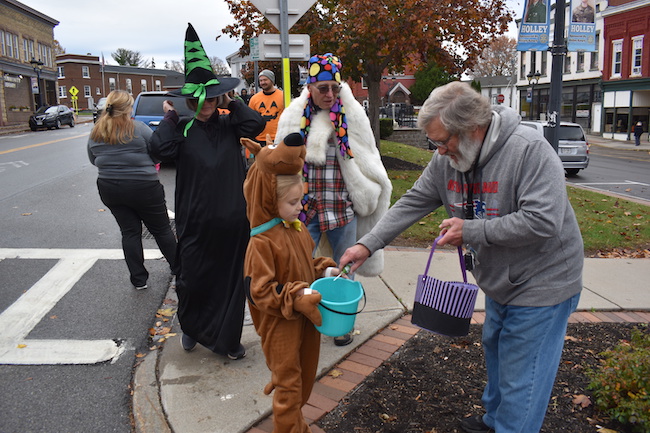
During Holley’s Hallow Fest in 2023, Bill Moroz hands out candy to Teagan, who dressed as Scooby Doo while joined by her grandparents, Tolanda and Dan Kronfield.
Holley will have its Fall Hallow Fest on Saturday with a costume parade at 10 a.m., with the lineup starting at 9:45 a.m. at the pharmacy.
There will be vendors from 10:30 a.m. to 3:30 p.m. at the American Legion and bounce houses at the old Holley High School. Trick or treating will be later throughout the village.
The Holley Police Department and Holley Volunteer Fire Department will be doing trunk or treat from 3 to 6 p.m. on Thomas Street between the police department and fire hall.
Community organizations and residents can set up a “trunk” beginning at 2 p.m. Contact Shannon at Smcmillion702@yahoo.com to reserve a spot. Trick or treaters are welcome in costume.