By Tom Rivers, Editor Posted 27 October 2026 at 9:14 pm
Rendering from Empire State Development and Governor’s Office: The Canal Basin parking lot along the Erie Canal will be turned into a “waterfront gateway” complete with green space, seating areas and boater/cyclist amenities as part of the NY Forward grant in Medina. This is not the final design for the parking lot. This is not the final design of the project.
MEDINA – The Village Board on Monday hired an engineering and design firm for a new look of Medina’s Canal Basin, a project that will better connect boaters and pedestrians to the basin, and improve the aesthetics of a space that is heavily asphalt.
Village officials last week interviewed six firms that submitted proposals for the project. On Monday, the Village Board hired Fisher Associates in Rochester.
Fisher called its proposal for the project, “Distinctly Medina: A Generational Vision for the Canal Basin.”
Fisher, in its presentation to the village, said the project will create “Medina’s definitive place on the Erie Canal for the next 20 years and beyond.”
The Village Board hired Fisher with the design services of the Canal Basin at $111,615 with an additional $17,955 for engineering and design work for electric car charging stations. It would be another $18,995 if a topographic survey is needed.
The Canal Basin parking lot will redesigned as part of a $1.345 million grant from the state. The new lot will have less asphalt and more green space. The parking lot will lose about 15-20 spaces. There will be about 70 spots remaining.
The project will add green space, seating areas and boater/cyclist amenities.
The redesigned basin was awarded $1.345 million of the $4.5 million from the state to Medina in the NY Forward grant. The state finalized eight projects for the $4.5 million on May 17, 2024. The transformed parking lot received the largest grant of the eight projects.
The village is looking to upgrade the entry drive from Main Street; enhance the pedestrian walkway extending from Main Street, across rear building facades, to East Center Street alleyway; add a gazebo for shade and cover; expand flexible greenspace areas for programming with amenities including seating tables, benches, bike racks, shade trees and native plantings; and add pedestrian walkways with decorative, permeable pavers.
The redesign of the basin parking lot also will include two direct-current fast chargers for electric vehicles, each with two charging spots. The state awarded Medina $245,184 in a separate grant for those chargers with National Grid also chipping in $73,000.
By Tom Rivers, Editor Posted 27 October 2026 at 12:07 pm
Photos by Tom Rivers
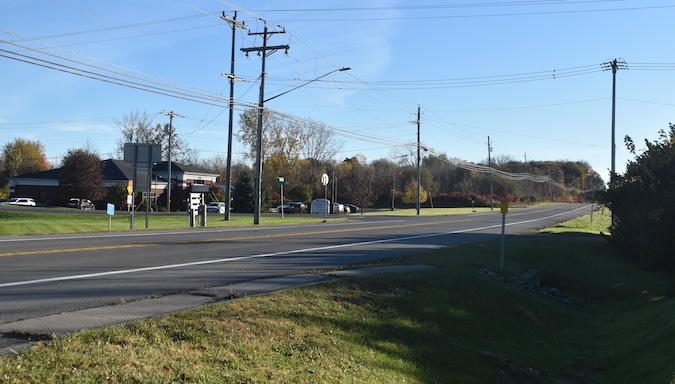
ALBION – Sidewalks run along the south side of East Avenue but stop across the road from St. Joseph’s Catholic Cemetery.
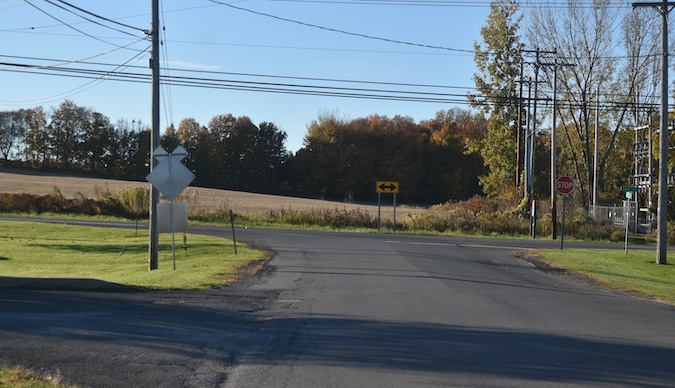
Albion town officials would like to see a joint project with the town and village to extend sidewalks to the Butts Road intersection and then going north on Butts past a healthcare site and then to a UConnectCare residence.
The Albion Town Board discussed the issue during its board meeting on Monday evening. The board said it will reach out to the village about a joint effort, and also see if there is any state funding to help with the sidewalk.
Mike Neidert, the Albion town highway superintendent, said he the sidewalks would be safer for pedestrians and people using scooters and wheelchairs to go to the healthcare facility and UConnectCare.
“This would be a great project,” he said. “There are a lot of pluses.”
Orleans Community Health in 2012 opened the healthcare center at the northeast corner of Butts Road and Route 31.
UConnectCare last November opened a residence that can serve up to 25 women including 5 bedrooms for women with young children.
Neidert said both UConnectCare and Orleans Community Health would like an extended sidewalk down Route 31 and on the section of Butts Road, as well as a crosswalk at the intersection.
The highway superintendent said the town and village could discuss having mucnipal employees install the sidewalks. He estimated there would be about 600 feet of sidewalks that the town would be responsible for, while the village would have about 1,500 feet.
He would like to see the town and village leaders reach out to Assemblyman Steve Hawley and State Sen. Rob Ortt to see if they could secure funding for materials for the sidewalks. He estimated the materials for 600 feet of sidewalks for the town’s portion would be about $10,000.
Mike Neidert, the Albion highway superintendent, would also like a cross walk at the intersection.
By Tom Rivers, Editor Posted 27 October 2026 at 10:50 am
Holley welcomes trick-or-treaters for Hallow Fest on Saturday
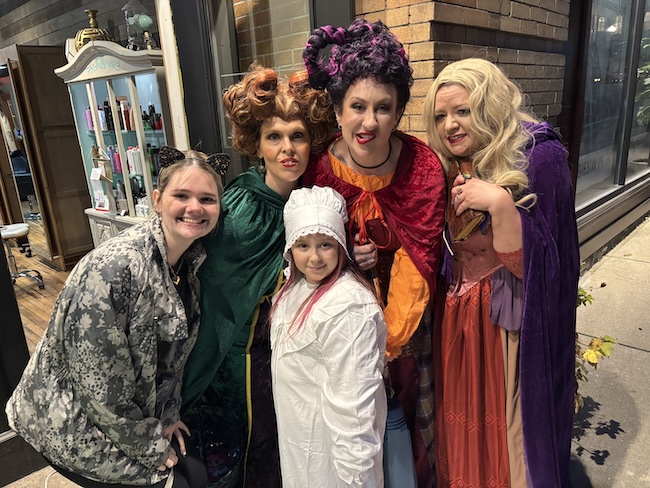
Photos by Tom Rivers: During Beggar’s Night last year on Oct. 25, the Fringe not only passed out candy but dressed up as characters from Hocus Pocus. In front, Khloe Mank, 9, is Emily Binx. In back from left are Leah Printup as Thackery Binx (the iconic cat), Jennifer Printup as Winifred Sanderson, Amanda Mank as Mary Sanderson, and Vanessa Lhommedieu as Sarah Sanderson. Lhommedieu is owner of The Fringe.
It will be candy galore and many kids in costume during Beggar’s Night on Friday in the Albion and Medina downtown business districts, and then on Saturday in Holley for the Hallow Fest.
Hundreds of children are expected in the downtowns of all three villages for the events.
The Albion Merchants Association is organizing Beggar’s Night in Albion from 5 to 7 p.m. Many businesses and organizations will be giving out treats to children. There will be a bonus of 20 gold bars filled with candy and goodies to some of the kids in the best costumes.
There isn’t a specific starting spot. The trick or treating line goes in a loop. People can park behind the fire department, next to Courthouse Square or the small municipal lot on Platt Street.
Medina businesses will have Beggar’s Night from 5:30 to 7 p.m. The starting point is the Print Shop on East Center Street and attendees often line up through the parking lot behind the buildings.
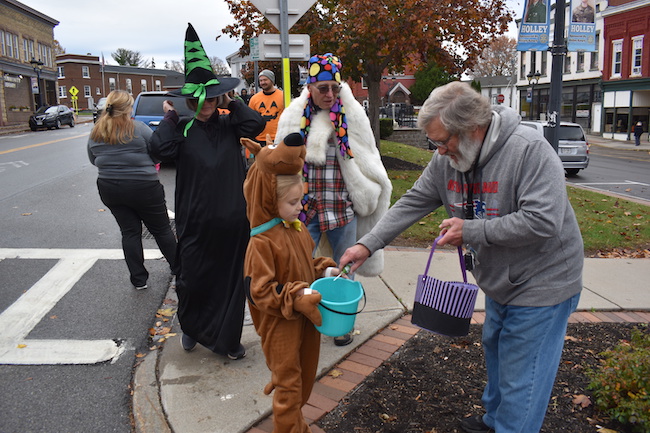
During Holley’s Hallow Fest in 2023, Bill Moroz hands out candy to Teagan, who dressed as Scooby Doo while joined by her grandparents, Tolanda and Dan Kronfield.
Holley will have its Fall Hallow Fest on Saturday with a costume parade at 10 a.m., with the lineup starting at 9:45 a.m. at the pharmacy.
There will be vendors from 10:30 a.m. to 3:30 p.m. at the American Legion and bounce houses at the old Holley High School. Trick or treating will be later throughout the village.
The Holley Police Department and Holley Volunteer Fire Department will be doing trunk or treat from 3 to 6 p.m. on Thomas Street between the police department and fire hall.
Community organizations and residents can set up a “trunk” beginning at 2 p.m. Contact Shannon at Smcmillion702@yahoo.com to reserve a spot. Trick or treaters are welcome in costume.
By Ginny Kropf, correspondent Posted 27 October 2026 at 8:12 am
Dan Fuller’s family has generations of service as soldiers
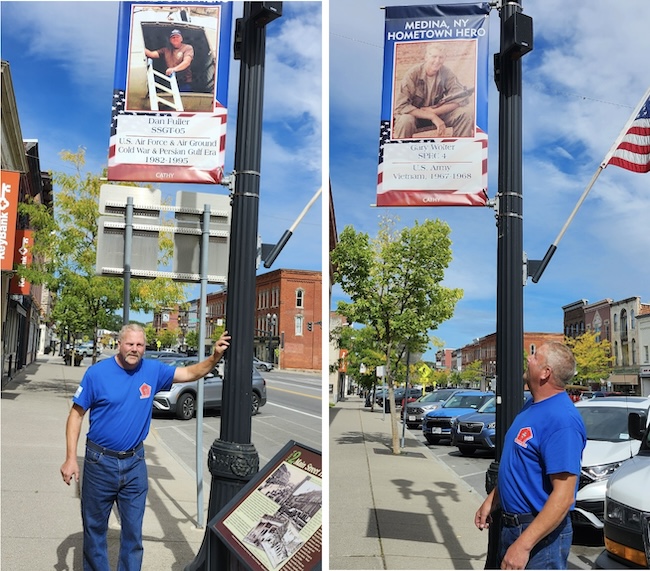
Photos by Ginny Kropf: (Left) Dan Fuller of Medina stands under his Hometown Heroes banner currently up on Main Street near the Presbyterian Church. He served with the U.S. Air Force and Air Ground during the Cold War and Persian Gulf era. (Right) Three members of Dan Fuller’s family have Hometown Heroes banners up this year. Here, Dan stands under the banner for his uncle Gary Wolter. Wolter served with the Army in Vietnam.
MEDINA – The banners for Hometown Heroes in Medina was started by Mary Woodruff after she saw a banner for her father-in-law while visiting his hometown in Alfred, south of Buffalo, in 2018.
She came home, presented the idea to the Village Board, and in 2019 Medina had its first Hometown Heroes’ banners. There were 38 in that first year. Banners are up for three years from around Memorial Day to just after Veterans’ Day, then they are returned to the family, Woodruff said. This year, the 2024 banners will be returned to the families.
The banners do more than showcase local heroes. For many of them, there is a story behind the banner.
Such is the case of Dan Fuller of Medina and his grandfather and uncle.
Fuller, commander of the Gasport American Legion, is one of 151 Hometown Heroes whose banners hang on the streets of Medina. Fuller served four years in Homestead Air Force Base as a radar repairman –and nine years at Niagara Falls with the Air National Guard.
Dan is a son of Paul Fuller, who was a corporal in the Air National Guard, serving from 1957 to 1963. What makes Fuller the proudest is his family’s history of serving their country. Not only does Fuller have a banner, but his uncle Gary Wolter and grandfather Harold Wolter also have banners hanging on Main Street, all sponsored by a family member who wished to remain anonymous.
Harold served in World War II as a nurse/field medic. He is a Purple Heart and Bronze Star recipient, having been a prisoner of war in Germany. He was called home after one year to run the family farm.
Dan’s Uncle Gary served from 1967-68 in Vietnam, and Gary’s son Chad was in the Marines.
Their ancestor Erastus Fuller served during the Civil War.
Dan has a long list of relatives who served their country, besides his uncle and grandfather – Bud Fuller, Bill Menz and Merle Draper, all of whom Dan says are heroes in his life.
In addition to his relatives, Dan says he looks up to Cliff Grant of Gasport.
“He is here because another guy took a bullet in front of him,” Dan said. “There are so many other stories that could be told.”
Dan Fuller’s story is just one of patriotism displayed in Medina’s banners. There are heroes, patriots and veterans from all branches of the military and the space program honored on Medina’s streets. Some served statewide, many went to battle and others were prisoners of war or Bronze Star and Purple Heart recipients. And others were killed in action.
There are numerous banners of families who had several members who served, such as Joseph Balcerzak and his son Paul. Joseph served in World War II and Paul in Vietnam.
Thomas Fisher served with the U.S. Air Force and his son Patrick was an Army veteran in the Persian Gulf War.
Robert Kerr and his son William were both World War II veterans – Robert with the U.S. Army and William with the U.S. Navy.
Terry Boyle served 10 years in the Army, six months of it in active duty on the front lines during the Gulf War. His son Zachary had three years in the Marine Corps.
There are several Civil War veterans honored with banners – two of whom are Patty Blackburn’s great-grandfather Henry Waters Jr. and Ziba Roberts Jr., great-great-grandfather of Virginia Kropf and Norma Fisher, and great-great-uncle of several members of the Roberts family.
Woodruff was thrilled last year to hang banners for two Revolutionary War veterans – Benjamin Darling, who lived on East Shelby Road and is buried in the Maple Ridge Road Cemetery, ironically on land owned by Ziba Roberts’ grandfather Daniel Roberts. Darling and Daniel both served in Connecticut, under the same leader.
Another veteran was Ed Grabowski’s father Leo, who survived the Bataan Death March – a story which will be featured in an upcoming story.
Families wishing to purchase banners may contact Woodruff at mbwoodruff16@gmail.com. The deadline for 2027 banners was Oct. 16, but Woodruff will take orders for 2028 banners. Cost is $200 per new banner.
By Tom Rivers, Editor Posted 26 October 2026 at 10:37 pm
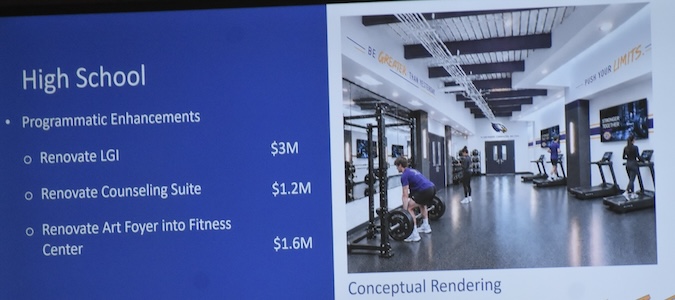
Photos by Tom Rivers: This slide was presented during the Board of Education meeting on Oct. 5 and shows the concept of turning the art foyer at the high school int a fitness center.
ALBION – The Board of Education voted this evening to send a $39.9 million project to the community for a public referendum on Dec. 17.
The board considered three different options for the capital project, with the options at33.4 million, $39.9 million and $47.3 million.
The district’s Finance Committee recommended the second option at $39.9 million, said John Kast, the board’s vice president and chairman of the Finance Committee.
The project will address many needs in the district, and Albion already has the local share set aside so no new local taxes will be needed.
Kast said the project will be 90.6 percent reimbursable in state aid.
Voting on the project will be from noon to 8 p.m. on Dec. 17. If voters back the project, it will go to a design phase that will need the State Department of Education’s approval before the project goes to bid. Construction could take place over three years.
The proposed project also includes work at all three school buildings as well as the bus garage. The price in the three options varied depending on the scope of work in the elementary school.
The new project includes some elements that were considered for the previous project, but were removed, Hunsinger said.
The project could include the following:
High School
Renovate Ag, IT and wood shop – $6.1 million
Greenhouse addition – $1 million
Renovate LGI – $3 million
Renovate counseling suite – $1.2 million
Renovate art foyer into fitness center – $1.6 million
Digital athletics/arts wall of fame – $200,000
Replace areas of damaged roofing – $100,000
Remediate sewer odor in athletics vestibule – $100,000
Middle School
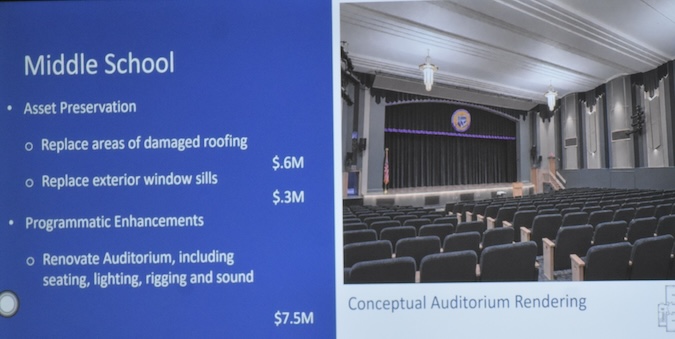
The auditorium in the middle school would be renovated while preserving its Art Deco character.
Renovate auditorium, including seating, lighting, rigging and sound – $7.5 million
Replace areas of damaged roofing – $600,000
Replace exterior window sills – $300,000
Provide security film on at-grade windows – $200,000
Elementary School
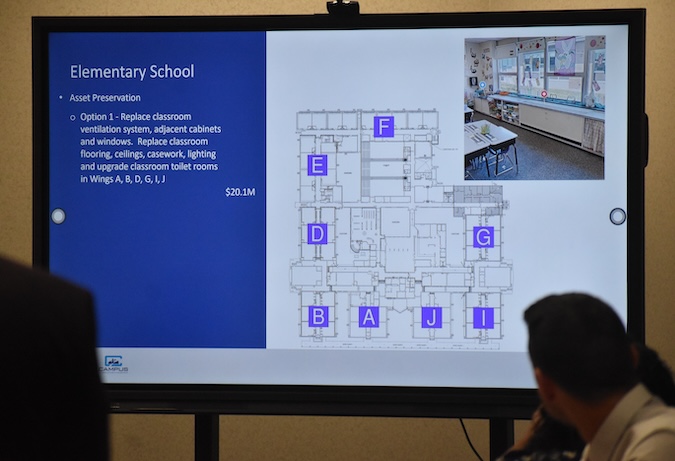
The scope of work for new ventilation systems, cabinets and windows ranged from $6.2 million to $20.1 million depending on the three options. The Board wants to address A, B, J and I for full replacement at a cost of $12.1 million with the other sections to be considered in future capital projects.
Replace east playground at $2 million
Replace west playground surfacing at $800,000
Renovate main entrance courtyard at $300,000, with $200,000 to add snow melt
Provide security film on at-grade windows at $200,000
Replace classroom ventilation system, adjacent cabinets and windows; replace classroom flooring, ceilings, caseworks, lighting and upgrade classroom toilet rooms wings A, B, J and I at a cost of $12.1 million. Doing all sections would have added about $8 million to the total.
Transportation building
Replace trench drain in storage and service bays at $200,000
Replace areas of damaged roofing, $30,000
The district worked with the Campus Construction firm to identify the scope of the project.
The cost estimates represent about a 21 percent increase from the current construction prices. Campus Construction is estimating a 7 percent price increase in construction each year. If the work is done in two to three years, the company is estimating a 21 percent escalation in construction costs
If the project is approved by the voters on Dec. 17, the district will shift $15 million into a capital reserve fund to pay the local share of the project. The district would take that as part of $30 million in undesignated funds, said Rick Recckio, the district’s assistant superintendent for finance.
He expects Albion would only need about $8 million of that $15 million to pay towards the local share of the capital project with Albion paying on the project over 10 years.
The project addresses top priorities identified through a building conditions survey that included input from building leaders in the district, said Mickey Edwards, the district superintendent.
The survey established a list of priorities ranked from 1 to 4. The final list includes the “priority 1’s,” he said.
“You never exhaust the list,” he said.
Albion is on a cycle of doing a capital project about every five years. Other issues identified in the building conditions survey but not in the final project could be considered again in about five years if the new project is approved by voters, Edwards said.
Board of Education member Chris Kinter has a possible project for the future. He wants to see a better way for parents to pick up and drop off their kids at the elementary school. He said cars often get stacked in a line on Clarendon Road that stretches out to East Avenue. He thinks more room for cars on the school campus would keep the line from going out on Clarendon Road and onto Route 31.
By Tom Rivers, Editor Posted 26 October 2026 at 2:47 pm
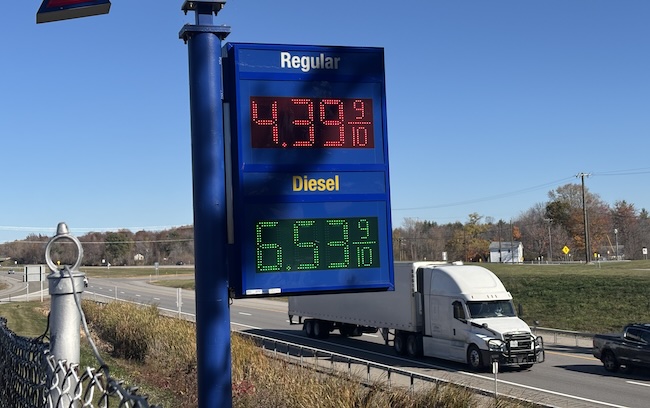
Photo by Tom Rivers: The gas prices at the Sunoco station in Angola along the State Thruway were at $4.39 for regular unleaded and $6.53 for diesel on Sunday.
AAA is reporting today that the average price for regular unleaded dropped 6 cents in the past week to $4.29 a gallon, which is up from the $3.03 price a year ago.
In New Yor State, the average price is at $4.42 today, down three cents in the past week and up from $3.13 a year ago.
“Gas prices aren’t budging much as crude oil prices remain high at $99 to $107 per barrel this morning,” AAA said in a news release. “The national average has stayed above $4 per gallon since late July and is currently more than a dollar higher than it was this time last year. Fall months typically bring lower gas prices, but volatility in the oil market has led to seasonal record highs this year.”
Here are the average prices at counties around Western New York:
Orleans, $4.410
Genesee, $4.349
Monroe, $4.371
Niagara, $4.349
Erie, $4.358
Wyoming, $4.420
Livingston, $4.394
Chautauqua, $4.390
Cattaraugus, $4.299
Allegany, $4.404
Hamilton County in the Adirondacks is the highest in the state at $4.737 a gallon, while Seneca County has the lowest average at $4.160.
The national diesel price is at $6.31, up 5 cents from last week and up from $3.63 a year ago. In New York, the average diesel price is $6.50 per gallon, down a penny from last week. A year ago, the average price was $3.87 per gallon in NYS.
By Tom Rivers, Editor Posted 26 October 2026 at 2:19 pm
ALBION – Orleans County had nearly 700 people cast ballots on the first two days of early. There were 663 voters total with 381 on Saturday and 282 on Sunday, according to the Orleans County Board of Elections.
There are seven more days of early voting in Orleans County with many positions on the ballot, including a race for governor, Congress and many other offices at the state, county and town levels.
There is one polling location open in the county for early voting. It is at the Orleans County Board of Elections Office, 14016 Route 31 in Albion.
During the general election on Nov. 3, there will be polling locations at each of the 10 towns in Orleans County.
The remaining early voting schedule includes:
Monday, October 26 – 9 a.m. to 5 p.m.
Tuesday, October 27 – 12 p.m. to 8 p.m.
Wednesday, October 28 – 12 p.m. to 8 p.m.
Thursday, October 29 – 9 a.m. to 5 p.m.
Friday, October 30 – 9 a.m. to 5 p.m.
Saturday, October 31 – 9 a.m. to 5 p.m.
Sunday, November 1 – 9 a.m. to 5 p.m.
The nearly 700 voters in the first two days of early voting is far more than 9 days of a primary back in June when only 78 people did early voting in the county.
Dennis Hurd, a neighbor, was injured trying to save Greene
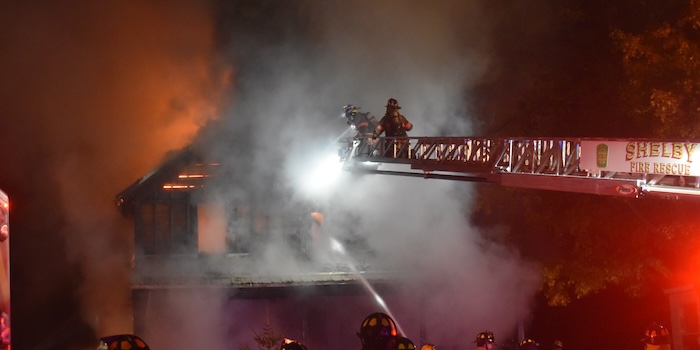
Firefighters on the Shelby ladder truck try to put out the flames at a fire on Thursday night at 12625 Presbyterian St.
Press Release, Orleans County Sheriff’s Office
KNOWLESVILLE – The Orleans County Sheriff’s Office is releasing the identities of the individuals involved in the fatal house fire that occurred on Thursday, October 22nd, at approximately 8:28 p.m., at 12625 Presbyterian Street in the Town of Ridgeway.
The individual who was found deceased inside the residence has been identified as David L. Greene, age 68, of 12625 Presbyterian St.
A second resident of the home that was transported to Strong Memorial Hospital in Rochester for treatment of injuries has been identified as Terrance T. Greene, age 25, of 12625 Presbyterian Street.
The neighbor who entered the burning residence in an attempt to rescue those inside has been identified as Dennis J. Hurd, age 67, of 12628 Presbyterian St.
During the rescue attempt, the neighbor sustained injuries after being overcome by heavy fire and smoke and was transported by Mercy Flight to Strong Memorial Hospital for treatment.
As previously reported, the neighbor became aware of the fire and, without hesitation, entered the burning residence in an effort to assist those trapped inside. Despite the dangerous conditions, the individual attempted to reach those inside before being forced to exit the residence.
The cause and origin of the fire remain under investigation by the Orleans County Sheriff’s Office, Orleans County fire investigators, and the New York State Office of Fire Prevention and Control.
The Orleans County Sheriff’s Office extends its sincere condolences to the family and friends of the deceased and recognizes the courageous actions of the neighbor who risked personal safety in an attempt to save another person’s life.
Additional information will be released as it becomes available and is appropriate for public disclosure.
Editor’s Note: A GoFundMe has been set up to assist Terrance Greene and his family. Click here for more information.
There is also a GoFundMe for Dennis Hurd, who was badly burned and faces a long hospital stay, according to his family. Click here for more information.
Press Release, Orleans County Office for the Aging
ALBION – The Orleans County Office for the Aging will be hosting a Medicare vendor fair on Nov. 10 at Hoag Library.
The fair is for Medicare beneficiaries during the fall Annual Open Enrollment period which runs from October 15th through December 7th. Open enrollment is the time for Medicare beneficiaries to review plan information and make educated decisions on what they want their coverage to be starting January 1, 2027.
During the vendor fair, representatives from Medicare Advantage Plans will be present to assist people in understanding changes in current plans and discuss any new plans for 2027. They can also help those interested enroll in a plan.
Attendees should bring their original Medicare Card and a list of both their prescription drugs and medical providers. Health insurance counselors from OFA will also be on hand to answer questions and screen for benefits.
The Medicare vendor fairs will be from 10 a.m. to 2 p.m. at the Hoag Library, 134 South Main St. in Albion.
Registration for the event is encouraged. Light refreshments will be served. For registration and additional information, call OFA at 585-589-3191.
Enterprises included road sprinkler to quell dust, coal yard along canal, bean-sorting operation
By Catherine Cooper, Orleans County Historian
“Illuminating Orleans” – Volume 6, No. 29
ALBION – This column features a sampling of evocative photographs of times gone by in Albion.
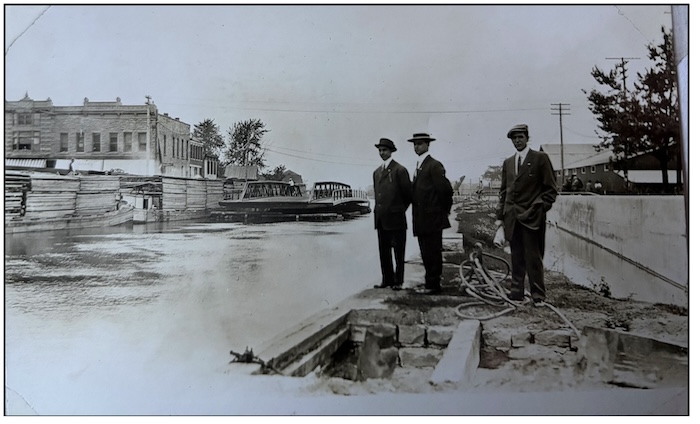
The top photograph dates to 1910 when the canal area adjacent to the swing bridge in Albion was being enlarged.
Ralph Vick, Maurice Schwartz and Don Campbell are seen here standing on the old canal bank which was dredged that summer. A fleet of boats ferrying a cargo of lumber waits its turn. The bridge swung from the center of the canal so that boats could pass on either side.
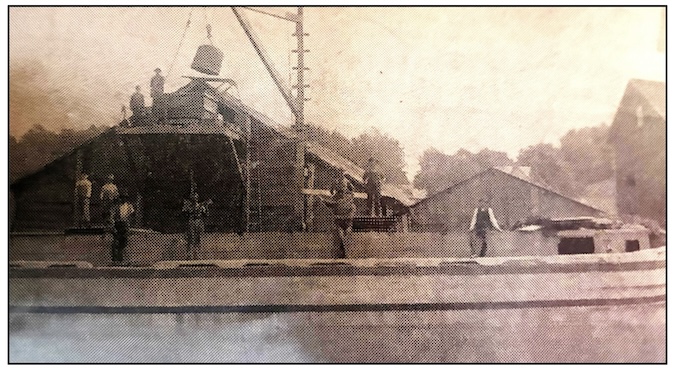
This 1905 photo shows coal being unloaded from a canal boat at John Howard’s Coal Yard at the foot of Clinton St., Albion. Hard, dusty work. Several men on the canal boat shoveled coal into the large bucket which was hoisted by pulley to the top of the large chute and then emptied into the coal barn.
Later, the coal was loaded onto wagons and delivered to area businesses and homes. Coal was the primary source of fuel for power and heat. John Howard’s was one of five coal yards located by the canal in the early 1900s.
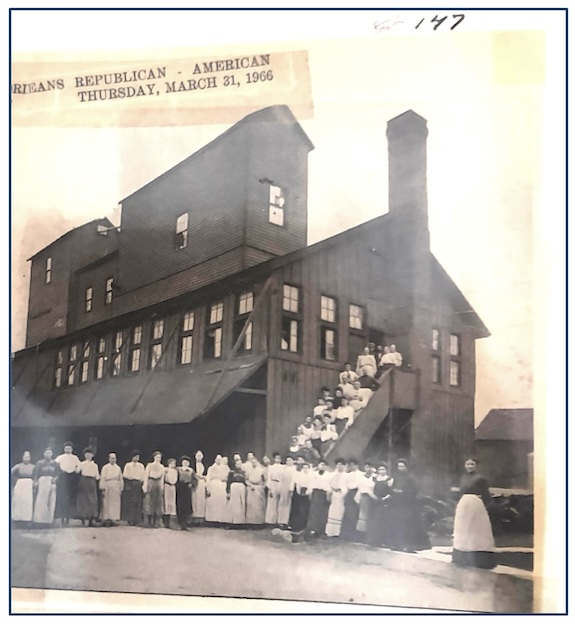
This eye-catching photo shows a group of about 50 female workers who worked during the winter months at the M. W. Tilden warehouse located at the north end of West Academy Street. in Albion. The workers hand sorted beans on a conveyor belt and removed imperfect beans, stones and debris. Rejected beans, known as “poor beans” were sold to farmers who cooked them to feed swine.
The photograph was taken in 1911, around the time the warehouse was purchased by the state for the canal widening project. As it transpired, that area was not used in the widening project.
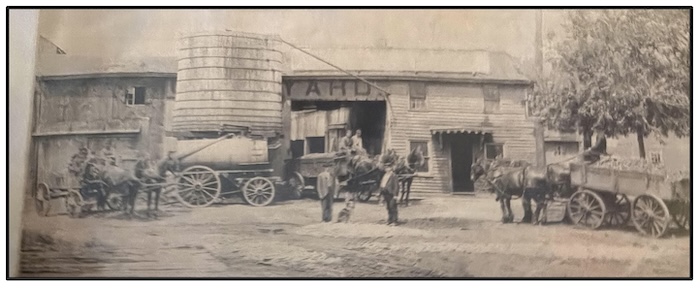
Unpaved municipal streets became very dusty during the summer. Sprinkling water on road surfaces helped quell the dust. The Village of Albion contracted with Shourds Bros., then located on the north end of Platt St., to provide this service which was included in property taxes.
If a property owner was delinquent in payment of taxes, the street area in front of that property was not sprinkled. Shourds Bros. also sprinkled the racetrack at the Orleans County Fairgrounds before and after every race and as otherwise needed.
A water tank can be seen in the center of the photograph. A large wooden tank is being filled. The tank sits on a wagon which was pulled by a team of horses.
By Ginny Kropf, correspondent Posted 26 October 2026 at 8:11 am
Provided photos: This group enjoys a previous Treasure Island fundraiser at the White Birch Golf Course. The 32ndannual event will be on Nov. 7.
LYNDONVILLE – Trips to Cape Cod and Myrtle Beach, Bills tickets and about 100 other prizes await those who attend Orleans Community Health’s 32 annual Treasure Island.
The gala fundraiser will take place Nov. 7 at White Birch Golf Course, beginning at 5 p.m.
Sponsored by Orleans Community Health Foundation, the event has brought the community together for a night of fun in support of local healthcare, according to Foundation director Megan Johnson.
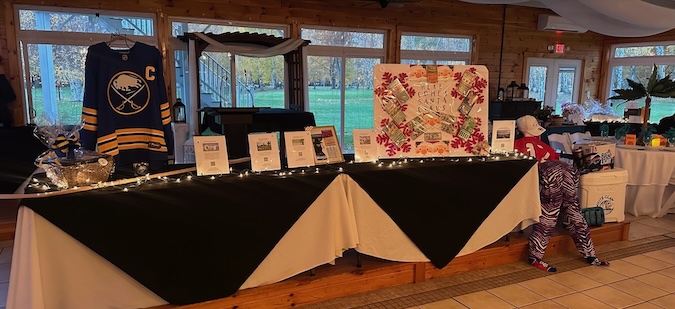
This year’s event features more than 100 silent auction items, 11 dinner stations, a three-hour open bar and music provided by DJ JT Thomas. Live auction packages include a one-year membership to Shelridge Country Club, memorabilia from the Bills’ Super Bown eras and a package featuring cash and 14 different gift cards.
Treasure Island includes many sought-after items in its auction.
Silent auction items include tickets to Shea’s Theater, box seats to the Nutcracker, pizza for a year from Mark’s Pizzeria, overnight stays and free play at Batavia Downs, along with many other items and experiences – all donated by local business and individuals.
Bidding, for ticketed guests only, is online via the app, which can be accessed on the Orleans Community Health’s Treasure Island website.
Returning to lead the live auction will be Wes Pickreign.
Presenting sponsor is Seaway Insurance Associates, along with Palm Tree sponsors Takeform, Ontario Shores Federal Credit Union and Baxter; Coconut sponsors, Mitchell Family Funeral Homes, WNY Energy and Manning & Napier.
“We’re fortunate to have so many businesses and individuals who continue to support Treasure Island year after year,” Johnson said. “It’s a fun evening that brings our community together, but more importantly, every ticket purchased, sponsorships and auction donations help support the hospital and the care we provide to our friends, families and neighbors.”
Treasure Island is OCH’s largest fundraiser of the year. All proceeds benefit expanding essential health services and enhancing patient care at Orleans Community Health.
Tickets are $60 per person or $450 for a reserved table of eight. The event is open to guests age 21 or older. Tickets may be purchased online at https://auctria.events/Treasure Island.
Photo and information courtesy of Medina Band Boosters
The Medina Mustang Marching Band traveled to Greece on Saturday for their sixth competition this season. There were six bands in total in different classifications performing to a sell-out crowd in beautiful weather conditions.
Medina & Le Roy are both classed in SS2 and Medina scored 85.20 followed by Le Roy with 83.65.
Other bands performing this night were Marcus Whitman in SS3 with 77.20, Hilton in LS3 with 77.35, Greece in LS2 with 87.25 and East Irondequoit in SS1 with 90.0.
The season finale is Sunday, Nov. 1st in the Carrier Dome/JMA Wireless Dome in Syracuse when all of the bands that participate in this conference will perform in competition. This is approximately 50 bands in 6 different classes.
During the championships on Nov. 1, there will be nine bands competing in SS2. The schedule for that division includes:
By Tom Rivers, Editor Posted 25 October 2026 at 9:11 am
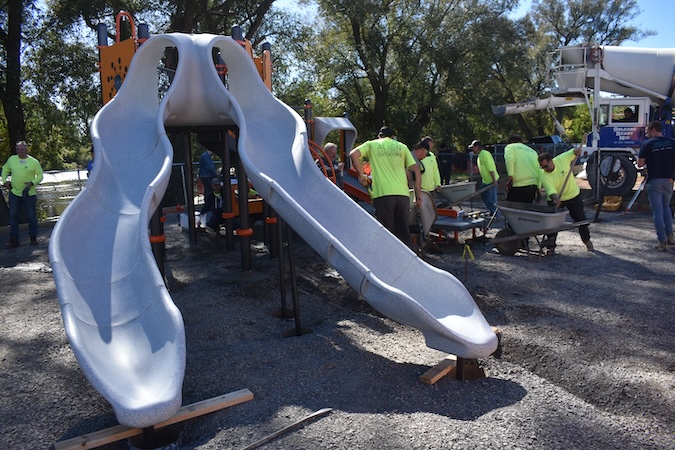
Photo by Tom Rivers: A team from Parkitects and others work to install playground equipment and pour concrete on Oct. 6 outside Lyndonville Central School.
LYNDONVILLE – The school district will celebrate a new playground for students and the community with a 9 a.m. ribbon-cutting ceremony on Wednesday.
The new playground is accessible for children with mobility issues and disabilities. The playground was designed and installed by Parkitects, a company owned by Lyndonville graduate Ben Frasier.
Parkitects donated about $250,000 in equipment and in-kind services to the playground. The school district also was able to use $160,000 in federal American Rescue Plan Act funds for playground equipment.
Frasier and a team of 18 Parkitects employees spent most of the day on Oct. 6 installing a new playground at Lyndonville. A rubberized surface also has since been added.
Orleans Ready Mix donated concrete for the project. Those donations were lined up by Steve Grabowski, the district’s director of facilities.
Other donations included: Watson Construction Group with removal/demolition of all of the old playground equipment and 14 inches of mulch; Barre Stone Company with 100 tons of crusher run stone; Shelby Crushed Stone with 100 tons of crusher run stone; Town of Yates with hauling the stone to the school; and Medina Lumber & Hardware with pressure treated 2×12’s covering 228 linear feet around the perimeter.
The new playground includes a We-Go-Round, Sway Fun Glider, We-Saw and other equipment that will be accessible to kids of all abilities and mobilities. The previous playground was over 20 years old and wasn’t handicapped accessible.
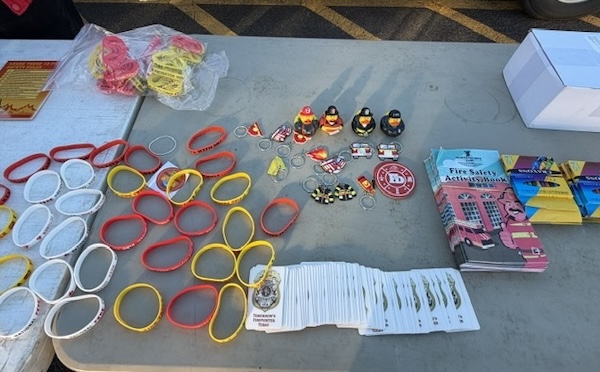
Photos and information courtesy of Kendall Fire Department
KENDALL – The Kendall Fire Department has officially wrapped up its 2026 Fire Prevention Week, following five days of educational activities, interactive demonstrations, and community involvement at Kendall Elementary School.
The week, held October 19–23, brought together firefighters, students, teachers, families, and neighboring emergency service agencies to promote fire safety awareness and teach potentially lifesaving skills.
Assistant Fire Chief James Fox of the Kendall Fire Department described the week as an overwhelming success, crediting the dedication of department members, school staff, neighboring agencies, and especially Deputy Chief Mike Cole, who was responsible for planning and coordinating the entire week.
“We had an absolutely incredible week,” Fox said. “I’m honestly not sure who enjoys Fire Prevention Week more, the kids or our firefighters. Seeing the excitement on their faces and watching them learn things that could someday save their lives makes all the planning and preparation worthwhile.”
The department organized a different set of activities each day, giving students multiple opportunities to interact with firefighters and learn about fire prevention.
Monday, October 19 – Fire Prevention Week Kickoff
The week began with Kendall firefighters greeting students as they arrived at school. Later that morning, firefighters visited kindergarten classrooms to read to students and introduce important fire safety concepts.
The day’s safety message encouraged families to check their smoke detectors and replace batteries when needed.
Tuesday, October 20 – Family Safety Night
Tuesday evening brought students and their families together for Family Safety Night, held from 5:00 to 6:30 p.m. at the Kendall Central School tennis courts and FTF building.
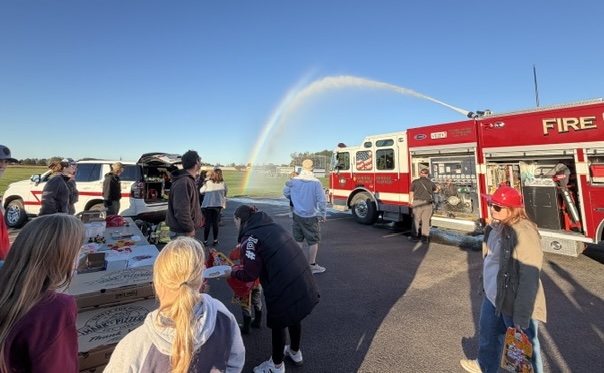
Families had the opportunity to explore fire apparatus, examine firefighting gear, learn about escape planning, and enjoy pizza while interacting with local firefighters.
The evening emphasized the importance of having a family fire escape plan and knowing what to do when a smoke alarm sounds.
Wednesday, October 21 – Firefighters Visit Kendall Elementary
Wednesday featured one of the week’s most interactive experiences as firefighters visited Kendall Elementary School during the school day.
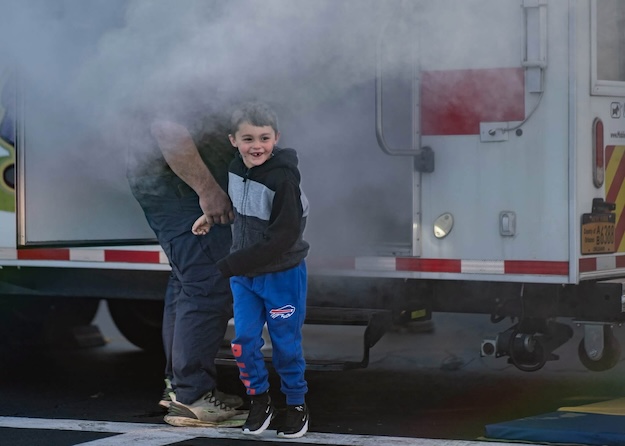
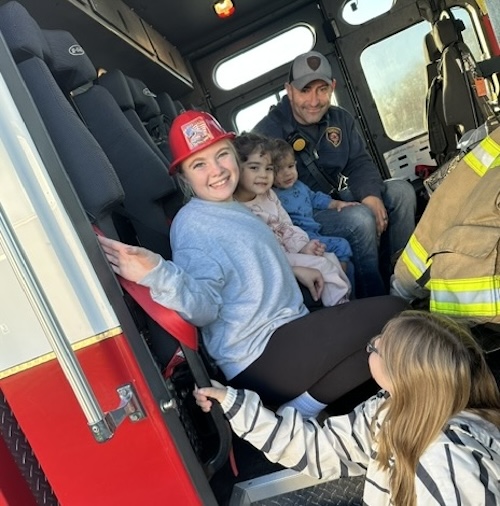
Students toured fire trucks, participated in fire hose demonstrations, and learned through a smoke simulator.
The Hamlin Morton Walker Fire District joined the activities, bringing its rescue truck and giving students a closer look at specialized equipment used during emergency operations.
Orleans County Emergency Management Office also assisted by providing its Smoke House Trailer, offering students an opportunity to learn about smoke conditions and safe evacuation practices.
“Having Hamlin come out with their rescue truck and the EMO provide the smoke trailer added so much to the experience,” Fox explained. “It gives the kids a chance to see equipment and learn things they might not otherwise have the opportunity to experience.”
Thursday, October 22 – Home Fire Escape Planning
Thursday’s activities shifted the focus to what students and their families can do at home to prepare for an emergency.
Students were encouraged to practice a home fire escape plan, identify a safe family meeting place, and discuss emergency procedures with their parents.
Families were also invited to participate in a special activity by submitting a photograph at their designated meeting location for an opportunity to enter a prize raffle.
“One of the biggest things we want kids to take away from this week is the importance of having a plan,” Fox said. “We want them going home and talking to their parents about smoke alarms, escape routes, and where everyone should meet if there’s a fire.”
Friday, October 23 – Firefighter Safety and the Pumpkin Drop
The week concluded Friday with firefighter safety presentations, a fire ladder truck question-and-answer session, and the highly anticipated pumpkin drop.
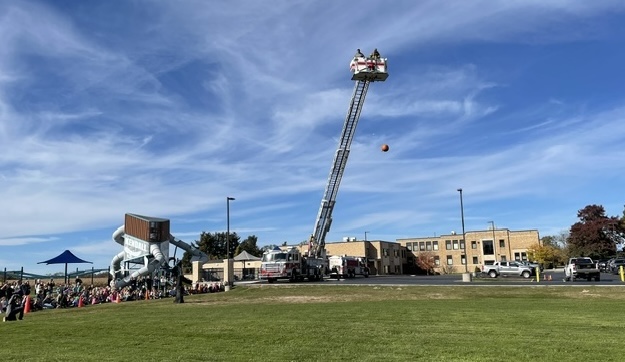
The Brockport Fire District brought its Quint, an aerial ladder truck, to Kendall Elementary School for the grand finale.
Students watched as pumpkins were dropped from the elevated ladder, providing an exciting conclusion to a week of learning and fun.
“The pumpkin drop was one of the highlights of the week,” Fox said. “The kids absolutely love it, and I think our members enjoy watching their reactions just as much. Having Brockport bring their Quint to help us finish the week was fantastic.”
Deputy Chief Mike Cole Recognized for Planning and Leadership
While Fire Prevention Week involved numerous firefighters and community partners, Fox made a point of recognizing Deputy Chief Mike Cole for the extensive work he put into organizing the entire event.
“I really want to give credit where credit is due, and that’s to our Deputy Chief, Mike Cole,” Fox said. “Mike planned this entire week and coordinated everything from start to finish. From working with the school and arranging the different activities to coordinating with neighboring departments and making sure everything came together, he put an incredible amount of time and effort into making this happen.”
Fox emphasized that much of the work involved in organizing an event of this size takes place long before students ever see a fire truck arrive at school.
“People see the fire trucks, the demonstrations, and the excitement, but they don’t always see the countless hours of preparation that go into making something like this possible,” Fox explained. “Mike deserves a tremendous amount of recognition for the work he did behind the scenes. He took the lead on this, and the success of the week really speaks for itself.”
Fox added that Cole’s commitment reflects the dedication of the department’s leadership and its continued investment in community education.
“We’re fortunate to have someone like Mike who is willing to put in that kind of time and effort for our community,” Fox said. “He did an outstanding job, and I want to make sure he gets the recognition he deserves.
Fox emphasized that an event of this size would not be possible without the cooperation of multiple organizations and countless hours of preparation.
The Kendall Fire Department extended special appreciation to the Hamlin Fire Department, Brockport Fire Department, Orleans County, and the Kendall Central School District.
“We couldn’t have done this without the support of our neighboring departments, the school district, and our own members,” Fox explained. “Everyone came together to make this a memorable experience for the kids.”
Fox also recognized the volunteer firefighters who dedicated their time throughout the week.
“Our members are volunteers. They have jobs, families, and responsibilities outside the fire department, but they still make time to come out and spend the day with these kids,” Fox said. “That says a lot about the dedication of the people we have in this department.”
More Than Just Fire Trucks and Fun
Although the week included plenty of excitement, Fox stressed that the primary mission remains education and prevention.
“Fire Prevention Week is about much more than showing kids fire trucks and letting them spray water,” Fox said. “We’re teaching them how to recognize dangerous situations, what to do when a smoke alarm goes off, and how to get themselves and their families out safely.”
Fox explained that building positive relationships between children and firefighters is another important benefit of the program.
“We want kids to recognize firefighters as people they can trust, especially during an emergency,” Fox said. “If a child ever experiences a fire, we don’t want them to be afraid of the firefighter coming to help them. We want them to understand that we’re there to keep them safe.”
Already Looking Ahead to 2027
While this year’s activities have concluded, the Kendall Fire Department is already preparing for next year’s event.
“Believe it or not, planning for Fire Prevention Week 2027 has already started,” Fox said. “Every year, we try to build on what we’ve done and find ways to make it even better. We want this to be something the students remember and look forward to every year.”
Fox concluded by once again recognizing Deputy Chief Cole, the department’s volunteers, and the community partnerships that made the week possible.
“I’m extremely proud of our department and everyone who helped make this happen,” Fox said. “Mike Cole deserves a lot of credit for putting this entire week together, and our members deserve recognition for stepping up and making it happen. We have an incredible school district, great neighboring fire departments, and firefighters who genuinely care about this community. When everyone comes together like they did this week, great things happen.”
For the Kendall Fire Department, Fire Prevention Week 2026 was not simply five days of activities. It was an investment in the safety, education, and future of the community’s youngest residents.
And with preparations for 2027 already underway, the department hopes to make next year’s celebration even bigger and better.



















 By Catherine Cooper, Orleans County Historian